17 August 2026
I'm Having An Existential Crisis. Please Send Help. (pt 1)
Friends, my immediate world is in a bit of a state.
Higher education across the UK is in the middle of sweeping redundancies. The cost of basically everything keeps rising. The country’s in a historic drought. And I am, as I write this, sitting in a café while a nearby couple remain deeply committed to watching TikToks on full volume.
It’s hard not to feel like something’s slightly off-kilter.
I’ll admit, LinkedIn is a strange place to post this. Especially while I’m contemplating the prospect of job hunting, which these days will potentially mean trying to find the words to express my lifelong passion for leveraging AI-powered solutions to maximise customer engagement and drive insights across a multi-stakeholder, B2B ecosystem. That’s what I always wanted to do when I was but a wee lad. If only there was a job like that out there :/
All this happens while simultaneously sitting with a growing feeling of unease about what I’m actually building toward. Where I want the next chapter to go. It’s the kind of moment where the sheer weirdness of the working world corners you and asks, bluntly: who, exactly, are you? Or rather, “why are you valid enough to earn a living?”
Yes, this is starting to sound like a cry for help. Maybe it is. But perhaps it’s a cry for me to help you (and why not both?).
This article’s title has likely provoked a certain image; the cartoon version of an existential crisis, someone hyperventilating into a paper bag, screaming “WHAT DOES IT ALL MEAN” at an increasingly concerned barista. But I think we need to re-evaluate that image a bit. Not just for my own sanity — which may be fraying slightly, but then again, whose isn’t — but because it is, technically, a bastardisation of the original concept.
It is my belief that existential crises are good to have. In fact, they are inevitable. Those who believe otherwise are just gearing up for an even worse time when it inevitably hits.
What’s actually happening
The psychotherapist Irving Yalom identified four “givens” of existence — facts of being that nobody gets to opt out of, however they try:
Death (sometimes called temporality). Life ends (sorry, spoiler alert). We carry a constant awareness of our own mortality, and of everyone we love. And in many ways, everything ends. Nothing is permanent.
Freedom. You technically can do anything you want in life. And since we’re the sole authors of our own choices, it means we also must take total responsibility for the actions we take. No refunds or store credit.
Isolation. Even surrounded by people, even inside a genuinely loving relationship, there remains an unbridgeable gap between your inner experience and everyone else’s. That’s just what it means to live. No one can be you fully.
Meaninglessness. The universe doesn’t ship with a purpose pre-installed. We build our own reasons for living. Both exciting and terrifying, depending on the day.
Yalom’s argument is that a huge amount of everyday anxiety is really just one of these four, wearing a disguise. To deal with it, we layer a whole lot of avoidance tactics to deal with the fact that it’s deeply uncomfortable to face these things. It makes it a very fun game to figure out what people are hiding from, but also grants insight into where we may face challenge in the future.
An “existential crisis,” properly understood, isn’t a breakdown, though it may feel like it. It’s the moment one of these existential givens stops being theoretical and becomes impossible to avoid — usually triggered by some sort of disruptive event, be it personal (risk of redundancy), global (world conflict), or even just a bit superficial (TikTok watchers in a cafe). It’s that disorienting wave of realising that your identity, your five-year plan, your micromanaging of staff, your carefully built sense of who you are, can’t actually protect you from any of this. That’s just it, man.
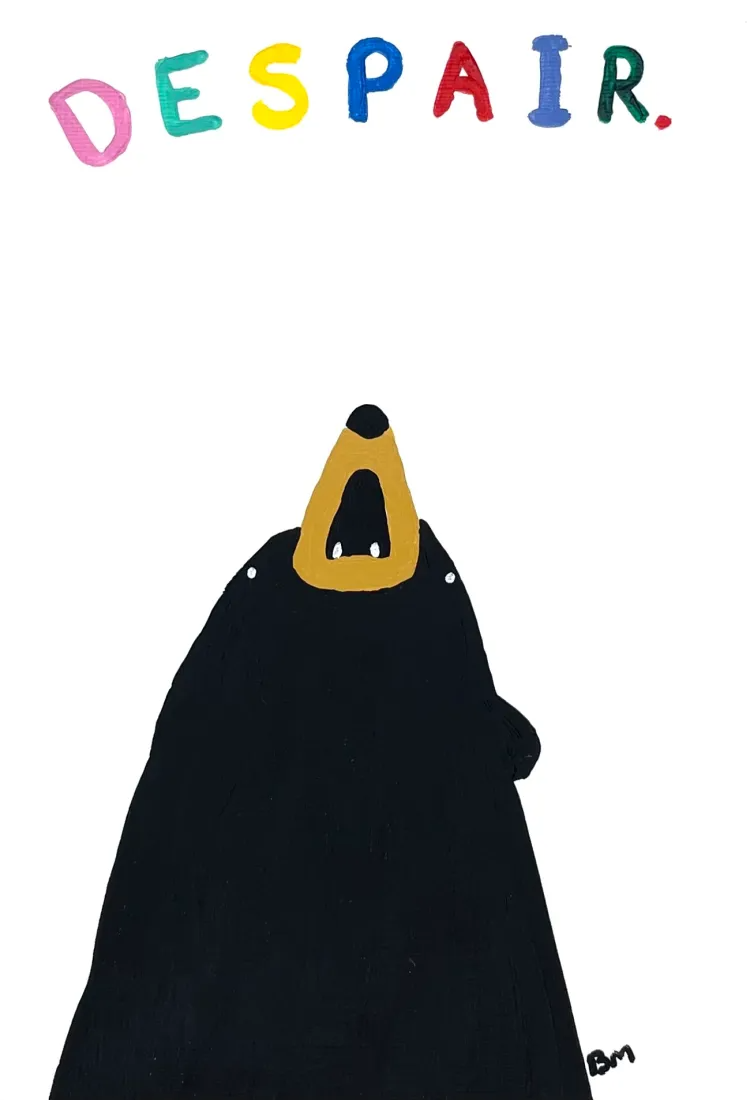 Art by Billy Murphy — billymurphyart.com
But is it really a malfunction? Well, no. It’s potentially one of the richest states to be in. It’s the time where you step outside those layers of avoidance and you can take steps towards renegotiating your relationship with the big, spooky, existential given itself. Could you possibly become frenemies? Well, that’s up to you.
It’s me, hi, I’m the problem, it’s me
Right now, freedom and meaninglessness are the big baddies I’m facing, but all of the givens have been present to spice things up.
My career was built quite unexpectedly around coaching and development, helping students find their footing as they navigate their own path. Turns out, on inspection, it may have been at least partly me looking for solid ground inside the meaninglessness too (how’s that for projection, eh). But by going through it myself, it means I’ve been pretty damn good at it, and seeing it from new angles. I’ve built frameworks that — credit where it’s due — do more useful work than a lot of the standard models this field tends to reach for by default.
But watching redundancy risk ripple across higher education this year has given rise to a bit of uncomfortableness: the ground I’d built all of that on was never as solid as it felt. Temporality rears its ugly head as I take a moment to see that all things eventually can come to an end. And thus, as I turn to look towards what may be next for me, it becomes a question of “well, what does a future me even look like?”
Figuring out where meaning might live in a more commercial world is… new to me, not because that world is against who I am, but because I simply haven’t found it there yet. It’s something that I know I can succeed at (mama didn’t raise no quitter), but the shift into “how do I change myself to fit that context” is tricky. On top of it all, it’s been hard to find an honest answer to the inevitable interview question I know I’ll face: what makes you think you can work in a business context instead of a university? (Apparently “trust me bro” is not a valid answer.) And not because I can’t, but because it requires the construction of new meaning.
Meaninglessness is fun because you have to put the work in to make something matter. If I can be fully honest: I know I can work in a non-educational context because people are people, wherever the building is, and I’m genuinely good at helping things happen when people are involved. That is the meaning I’ve found for myself, at least.
However, the challenge of isolation makes itself known: I can believe this and know it as much as I can for my own self… but is that enough? One questions the need to construct something glossier, more legible to an HR system, to even get the chance to prove it’s true. How do you explain any of my strengths to people for whom “existential given” isn’t a phrase they use casually over coffee? How do you translate “genuinely excellent at holding the complexity of another human being experiencing disorientation” into an application form that just wants to know if you can “collaborate effectively in a fast-paced team environment”?
And then there’s the freedom. I know I can move, shift direction, build something new. The actual difficulty was never permission (though this is certainly still a barrier). But the first step is actually deciding which direction, out of an uncomfortably large number of them, is actually mine to choose. There’s so many paths one can take, but the responsibility of what that means becomes a beast that is difficult to tackle on one’s own.
You can probably see how this tangles together fast. Maybe avoidance is better after all.
The choice, not the resolution
Yalom’s advice here — echoed by Kierkegaard’s idea of self-authorship, and by de Beauvoir’s notion of continual self-becoming, with a dash of Camus’ absurdity — isn’t that there’s a correct answer waiting to be found. It’s that the work is choosing to actually face the given, rather than building a more sophisticated way to avoid it.
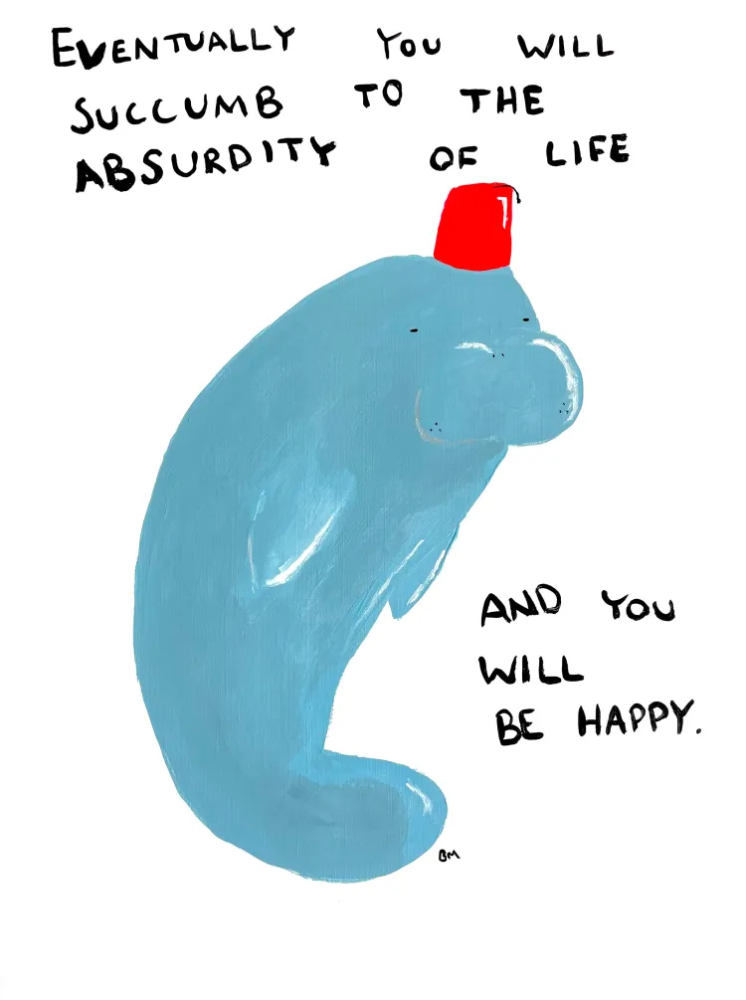 Art by Billy Murphy — billymurphyart.com
I could become bitter (it’s so tempting). I could ignore it all and just hope it all goes away (not my typical mode). Or I could just simply give up. But I spent a Sunday afternoon writing this tangent, so you know that’s not happening (and again, mama didn’t raise no quitter).
Unfortunately, I don’t have a tidy resolution to hand you, nor am I going to manufacture one just because an article needs a closing paragraph. Easy answers are just a way to add a new layer of avoidance. It’s also getting hard to focus on account of the loud TikToks.
What I do have is this: I’m trying to face it. I’m calling it out as a thing that is happening, rather than hunkering down and hoping it all goes away.
Yes, it’s odd to put in a LinkedIn post, but I haven’t gotten around to creating a Substack, and besides, LinkedIn needs a bit more humanity. I promise if you look at a lot of the posts on this site, there’s a lurking fear of an existential given somewhere. People wear it on their sleeves more than they care to admit.
At any rate, by calling it out, Yalom would probably call it a great start. I’ll take it as one too.
For now, let’s face those things together. Despite isolation, we can use our freedom to choose to create a meaningful way forward. And so we shall. And so it goes.
Part two, whenever I’ve actually got somewhere with this, to follow.